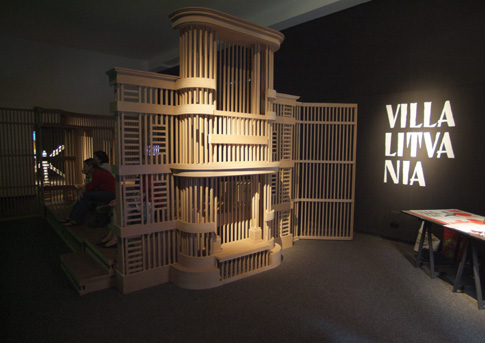
VILLA LITUANIA
project website: http://villalituania.lt/
The project takes its title — Villa Lituania — and conceptual impetus from a grand house that stands on one of Rome’s grand avenues. As the name of the property suggests the building is associated with the Lithuanian nation: it was the Embassy of the first independent Republic of Lithuania (1918–1940) to Italy. 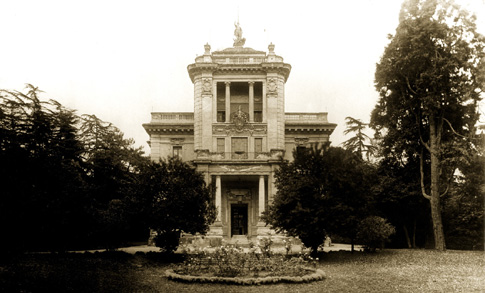
The Embassy operated from 1933–1940 but became a possession of the USSR after the Soviet occupation of Lithuania. The keys to the property, which had been in safe keeping, were handed by Italian government representatives to Soviet officials in step with the alliance of powers signaled by the Molotov–Ribbentrop Pact (1939).
Since the disintegration of the Soviet Union in 1990–91 and the formation of the Republic of Lithuania the Villa has remained the property of Russia; operating as the Russian Consulate in Rome. It is considered the last occupied territory of Lithuania, and successive Lithuanian governments have lobbied internationally for its restitution or reparation — and an offer of compensation made by the Italian government in May 2007 is currently under consideration.
The project proposes an architectural restoration of Villa Lituania — that has emerged from the symbolical field to brush with real politik. It attempts to render a process of reconciliation, and contribute to a discourse of urgent and topical socio-political debates, dealing with independence, autonomy, territory, property, as well as cultural collaboration, creativity and the relativity of freedom.
The site and history of the Villa Lituania are the source codes of the project—that is set to develop rhizomatically. In this case the artists aren‘t pursuing concrete political and social ends, or a locked-down media representation, rather they are producing a symbolic act too often missing from contemporary geo-politics: a 400 km professional pigeon race between Venice and Rome in which the racing birds compete for the “Villa Lithuania Trophy”.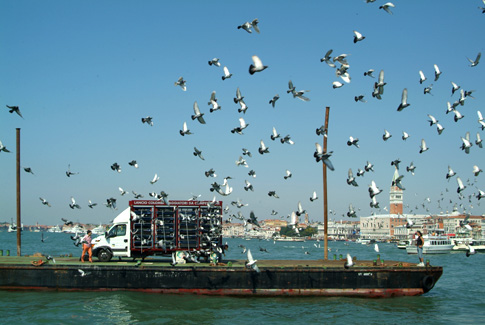
Working with pigeon breeders in Italy and Lithuania, Nomeda & Gediminas Urbonas are proposing to stage two pigeon races from a location at Campo S. Biagio in Venice. The first race scheduled on 9 June, 2007 is an international challenge race with birds racing to all points in Italy as well as Lithuania, Poland, and Russia. The second event is planned for the autumn of 2007 and is a special race from Venice to Rome. The race’s intention is clear — sending colomba della pace “doves of peace” to the occupied territory of Villa Lituania in Rome.
To achieve this, a pigeon-loft needs to be constructed in Rome. Pigeons’ metriculate the loft they make their first flight from as home and always return to that location when released — hence ‘homing pigeon’.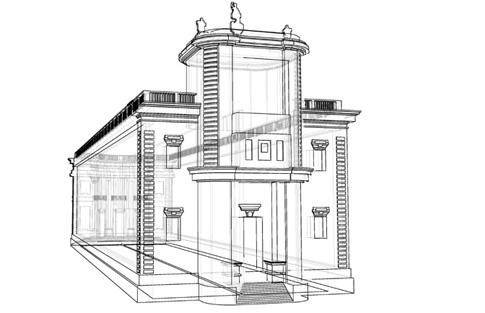
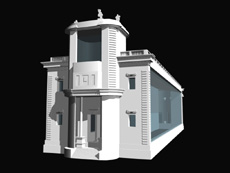
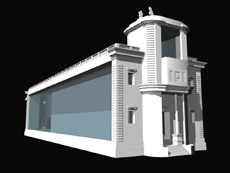
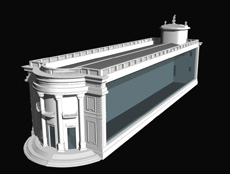
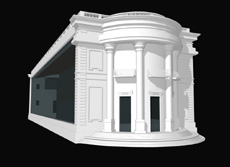
Once requests to build at Villa Lituania were effectively denied the artistic team turned their attention to the construction of a loft in a public park in Rome — a painstaking and protocol heavy procedure. Herein lays the brush with real politik as the artists are now immersed in political process beyond the scope of the majority of projects understood as ‘public’, ‘protest’, or ‘political’ art.
The fate of this element of Nomeda & Gediminas Urbonas’ project hangs-in-the-balance. As such the Pavilion exposition is an avatar, comprised of a large-scale sculptural model that synthesizes elements of the proposed loft and Villa Lituania; newly created video works that tell the story of the Villa Lituania project and the history of the Embassy; a trophy room for the pigeon races; and an installation of pro-test archive documenting the important work that the artists have been making in Vilnius protesting the encroachment by neo-liberal government and corporations on public space.